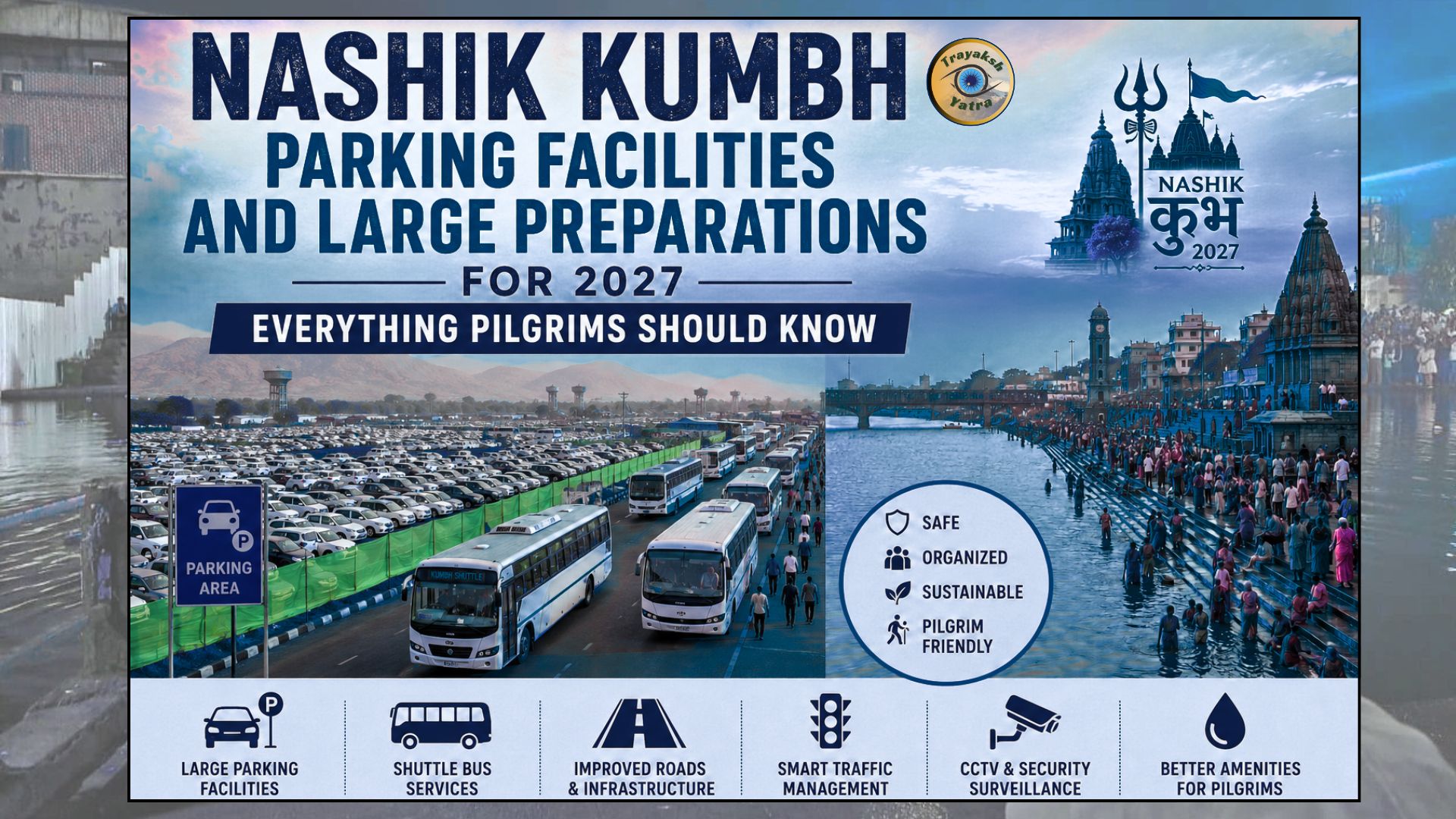
The Nashik Kumbh Mela 2027 (Simhastha Kumbh) is expected to welcome millions of devotees, saints, and tourists from across India and around the world. As one of the largest religious gatherings on Earth, managing such an enormous crowd requires extensive planning.
Maharashtra Government, Nashik Municipal Corporation (NMC), Nashik- Trimbakeshwar Kumbh Mela Authority and other departments are leaving no stone unturned to make sure that this pilgrimage for devotees is safe, organised and comfortable. Be it world-class multi-level parking, roads, pious ghats, shuttle services, smart traffic management and spruced-up public conveniences development work is going on in full swing well before time.
This blog explains the upcoming parking arrangements and the major preparations that visitors can expect during the Nashik Kumbh Mela 2027.
Why Parking Planning is Crucial for Nashik Kumbh 2027
The 2015 Nashik Kumbh witnessed severe traffic congestion due to the enormous influx of pilgrims arriving by private vehicles.
Learning from previous experiences, authorities are now developing a more advanced transportation system focused on:
- Reducing city traffic congestion
- Keeping pilgrimage routes pedestrian-friendly
- Improving emergency vehicle movement
- Providing faster access to bathing ghats
- Enhancing pilgrim safety
Instead of allowing vehicles into the crowded city centre, authorities are focusing on large outer parking hubs connected by shuttle buses.
New Parking Projects Needed During Kumbh
Nashik, a city in the state of Maharashtra, is known for its grand celebrations of the Kumbh Mela, one of the largest religious gatherings in the world. The city has been hosting this event every 12 years and attracts millions of pilgrims from all over India and abroad.
In addition to these efforts, smart technologies are being employed to keep track of available parking lots and help monitor them on real-time basis as well. It involves installing digital boards at prominent locations which will indicate availability of parking slots and the respective occupancy rates. Visitors will be able to plan better and save time this way.
- Major Road Development Projects Thousands of crores of rupees are being invested in infrastructure improvements before the Kumbh.
Key projects include:
- Widening major highways
- Construction of new roads
- Improved city connectivity
- Better access to Trimbakeshwar
- Strengthening bridges
- Upgraded intersections
The Nashik Municipal Corporation has stated that the major road projects are targeted for completion before the 2027 event.
- Smart Traffic Management – Modern technology will play an important role in traffic regulation.
Expected measures include:
- AI-based traffic monitoring
- CCTV surveillance
- GPS-enabled buses
- Digital traffic updates
- Real-time crowd monitoring
- Traffic diversion plans
- Emergency response coordination
Authorities are also studying successful crowd-management practices from recent Kumbh events to improve operations.
(C) Shuttle Bus Services
To reduce traffic inside Nashik city, authorities plan to operate thousands of shuttle trips throughout the day.
Expected features include:
- Frequent shuttle buses
- Electric buses for eco-friendly transport
- Dedicated bus lanes
- Easy access for senior citizens
- Routes connecting parking hubs with bathing ghats
- Connectivity between Nashik city and Trimbakeshwar
This system is intended to minimize walking distances while keeping the inner city less congested.
The number of pilgrims is likely to increase during Kumbh 2027.
Nashik is soon going to witness the never seen pilgrim rush during the Kumbh Mela in 2027. Nashik already is one of the four holy pilgrimage places for Hindus. But with Kumbh Mela coming and 2027 being a “Maha Kumbh” year it can be said that Nashik will witness a huge rise in the number of pilgrims visiting.
As per the municipal corporation’s estimates there will be nearly 40 crore devotees for Kumbh Mela in Nashik in 2027. This huge number is nearly twice as compared to earlier years and will be quite tough on Nashik in terms of providing shelter and transportation facilities.
There is a plan to build multi-level parking facilities in Nashik.
Multi-level parking lots would be constructed at entry points leading into the city and significant locations nearest the Kumbh Mela grounds. They seek to reduce traffic on routes to the fairgrounds and encourage parking for private vehicles and public transport.
Space saving is one advantage these multi-level parking complexes will offer. More vehicles can be parked in these tall buildings, as less ground space will be required. It will come in handy on busy days of the Kumbh Mela, when large number of vehicles descend on the city.
There will also be shuttle services from these parking lots to the Kumbh Mela Grounds themselves. This will allow for less congestion on surrounding roads and also provide visitors with time they would have spent walking from their cars.
How will the new parking system reduce traffic?
The newly designed parking system consists of parking lots all around the city that will lead to shuttles to designated spots near the main event areas. This is to avoid overcrowding of people trying to park in one specific place. It will also help promote people to take public transportation rather than driving themselves. NMC also worked with local private companies to have their own shuttle transportation to get around the city.
One of the biggest challenges during big events like Kumbh Mela is congestion due to mismanagement and lack of information available to commuters in real-time. At NMC, we’ve equipped our parking system with high-tech tools like GPS enabled tracking devices fitted in shuttle buses, real-time monitoring for hassle free movement.
- Possible Vehicle Restrictions – During major bathing days, private vehicles may not be permitted inside the core Kumbh zone.
Instead:
- Vehicles will stop at designated parking locations.
- Pilgrims will continue via shuttle buses.
- Some routes may become pedestrian-only.
- Emergency and official vehicles will receive priority access.
This strategy aims to improve crowd safety and traffic flow on peak days.
- Expected Benefits of the New Parking System – The upgraded parking and transport arrangements are expected to provide:
- Reduced traffic congestion
- Faster movement of pilgrims
- Improved emergency response
- Better crowd management
- Cleaner city roads
- Lower pollution through public transport
- Enhanced overall pilgrimage experience
Parking provided by NMC for Kumbh Mela can be described as a systematic and thorough attempt at decreasing traffic issues in Nashik. If managed correctly with technology and enforcement this new parking system should allow hassle-free travel for visitors and citizens during this massive festival.
Transport Services to Connect Parking Areas and Ghats
To ensure smooth movement of millions of pilgrims during the Nashik Kumbh Mela 2027, authorities are implementing a comprehensive park-and-ride transportation system. Under this arrangement, private vehicles will be directed to designated outer parking zones, while government-operated shuttle services will transport devotees closer to the sacred bathing ghats and temples.
- High-Frequency Shuttle Bus Network – The Maharashtra State Road Transport Corporation (MSRTC) is expected to deploy around 4,500 buses during the Kumbh Mela. Approximately 3,000 buses will operate between outer parking areas and inner pilgrim zones, while an additional 1,500 buses will connect major railway stations with key Kumbh locations. The integrated transport network has been planned to handle more than 3.3 million passengers per day during peak periods.
- Park-and-Ride System – The transport strategy follows a three-stage travel model:
- Pilgrims arriving by private cars, buses, or two-wheelers will park at designated peripheral parking facilities.
- Shuttle buses will carry visitors from these parking hubs to inner transit points located near the pilgrimage zone.
- From the inner drop-off areas, devotees will walk along dedicated pedestrian corridors to reach the Godavari ghats and major temples.
On major Amrit Snan (Shahi Snan) days, private vehicles will not be allowed inside the core pilgrimage area, helping maintain orderly movement and reducing congestion.
- Dedicated Routes and Traffic Management – To improve efficiency, shuttle buses are expected to operate on dedicated routes connecting:
- Outer parking hubs to Ramkund and nearby ghats
- Parking facilities to Trimbakeshwar Temple
- Major railway stations to pilgrimage areas
- Transit hubs across Nashik city
Authorities also plan to introduce dedicated bus lanes, GPS-based fleet monitoring, and real-time dispatch through an Integrated Command and Control Centre (ICCC). This will allow transport officials to adjust bus frequency based on crowd levels and minimize waiting times.
- Last-Mile Connectivity
Since large crowds are expected near the bathing ghats, pilgrims may need to walk the final 2–3 kilometers from designated inner parking or shuttle drop-off points to the ghats on peak bathing days. These routes will include barricaded walkways, clear directional signage, medical assistance points, drinking water stations, and security personnel to ensure a safe and organized pilgrimage experience.
- Benefits of the Transport Plan – The integrated transport system is expected to offer several advantages:
- Reduced traffic congestion around the ghats
- Faster movement of pilgrims between parking areas and holy sites
- Improved emergency vehicle access
- Lower pollution through reduced private vehicle movement
- Better crowd management on peak bathing days
- A safer and more comfortable pilgrimage experience for devotees of all ages
By combining extensive parking infrastructure with a reliable shuttle bus network, Nashik aims to deliver one of the most efficient transport systems ever implemented for a Simhastha Kumbh Mela.
Better Facilities for Pilgrims – Apart from transportation, several public facilities are being upgraded.
These include:
- Public toilets
- Drinking water stations
- Medical camps
- Temporary hospitals
- Information centers
- Police assistance booths
- Lost-and-found centers
- Resting areas
- Clean ghats
- Improved lighting
The goal is to provide a safe and comfortable experience for every pilgrim.
Environmental Initiatives
Preparations also include environmental improvements. Authorities have launched plantation drives and beautification projects as part of the Kumbh preparations, aiming to create a cleaner and greener environment for visitors.
Tips for Pilgrims Visiting Nashik Kumbh 2027
To make your journey smoother:
- Arrive early on Shahi Snan days.
- Use designated parking zones only.
- Prefer official shuttle services.
- Follow traffic advisories.
- Carry only essential luggage.
- Stay hydrated.
- Wear comfortable walking shoes.
- Keep your ID and emergency contact details handy.
- Travel with your group whenever possible.
- Follow instructions issued by local authorities.
Government Steps to Improve Visitor Experience
The government is undertaking major improvements to provide a better experience for visitors during the Nashik Kumbh 2027.
Key focus areas include:
- Road widening projects
- Ghat beautification initiatives
- Sanitation improvements
- Drinking water facilities
- Medical support centers
- Security enhancements
- Public transport upgrades
- Smart city technologies
Traffic Management Plans for Nashik Kumbh 2027
Managing the movement of millions of pilgrims is one of the biggest challenges of the Nashik-Trimbakeshwar Simhastha Kumbh Mela 2027. Maharashtra Government, Nashik Police,Nashik Municipal Corporation (NMC) & Nashik- Trimbakeshwar Kumbh Mela Authority are putting in place an effective traffic management plan aided with additional infrastructure and technology to enable seamless movement of people during the festival for public safety and successful emergency services management. Key roads will be upgraded prior to festival for smooth traffic movement.
- Park-and-Ride System – Importantly, there will be park-and-ride facility to minimise traffic inside the city. Pilgrims travelling in their own vehicles can utilise outer parking areas located on prominent routes entering Nashik. The pilgrims will then be ferried by government shuttle buses from these parking nodes to the drop-off points near Ramkund, Trimbakeshwar and other key pilgrimage locations.
- Dedicated Traffic Diversions – Many roads around Nashik and Trimbakeshwar are likely to be made pedestrian roads during the Kumbh Mela in Nashik, particularly on Amrit Snan (Shahi Snan) where Traffic has announced diversions for private vehicles and will open alternative routes. Shuttle bus corridors will be reserved for shuttles buses, ambulances, Police vehicles and other essential service vehicles.
- Sector-Based Traffic Control – To manage crowd and traffic flow better, Nashik and Trimbakeshwar will be divided into several sectors. Each of these sectors will have traffic police personnel, local police teams, doctors and quick response teams of their own. This will help authorities keep a check on traffic situation, flow of crowd and tackle any emergency without disturbing others at the pilgrimage site.
- Intelligent Traffic Monitoring – Modern technology will play a major role in traffic management during the Kumbh. Authorities are expected to deploy:
- AI-assisted traffic monitoring systems
- CCTV surveillance across key routes
- GPS-enabled shuttle buses
- Real-time traffic monitoring through an Integrated Command and Control Centre (ICCC)
- Digital message boards displaying route updates and advisories
These technologies will help officials detect congestion, reroute traffic when necessary, and provide timely information to pilgrims.
- Improved Road Infrastructure – To support the increased traffic volume, extensive infrastructure projects are underway across Nashik and Trimbakeshwar. These include:
- Widening major roads
- Construction of new link roads
- Development of the Nashik Ring Road
- Bridge improvements
- Upgraded intersections
- Better access roads to Trimbakeshwar and major ghats
These projects are intended to improve connectivity, reduce travel time, and ensure smoother traffic movement before the start of the Kumbh Mela.
- Priority for Public Transport – Public transport has been accorded priority status during the event. Thousands of MSRTC buses and city shuttles are anticipated to ply between railway stations, bus depots, parking sites and pilgrimage centers. The provision of bus lanes and exclusive pick-up & drop-off zones will ensure unhindered services even during times of massive congregation.
- Emergency Traffic Management – There will be dedicated lanes for ambulances/fire trucks/emergency/disaster management vehicles/police vehicles. They will be monitored to ensure they are always kept open for when there are medical emergencies/crowd management situations.
- Travel Tips for Pilgrims – To avoid delays and ensure a hassle-free pilgrimage:
- Use designated parking facilities instead of entering the city by private vehicle.
- Prefer official shuttle buses for last-mile travel.
- Check traffic advisories before starting your journey.
- Arrive early on major bathing days to avoid peak congestion.
- Follow instructions from police and traffic volunteers.
- Keep extra travel time in your schedule during the Kumbh period.
Conclusion
The traffic management plan for Nashik Kumbh 2027 combines upgraded infrastructure, smart technology, sector-based control, dedicated shuttle services, and well-planned traffic diversions to handle one of the world’s largest religious gatherings. These measures aim to provide pilgrims with a safer, faster, and more organized travel experience while ensuring uninterrupted emergency services and efficient crowd management throughout the festival.