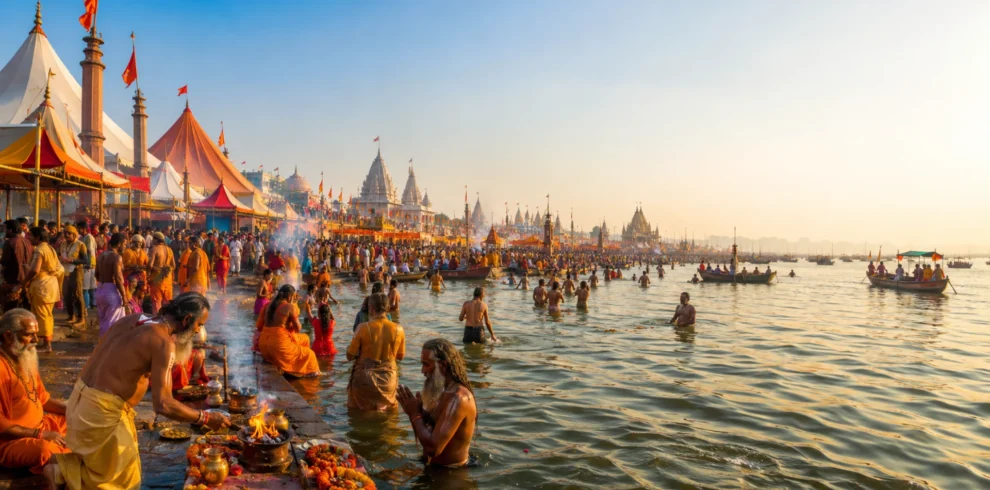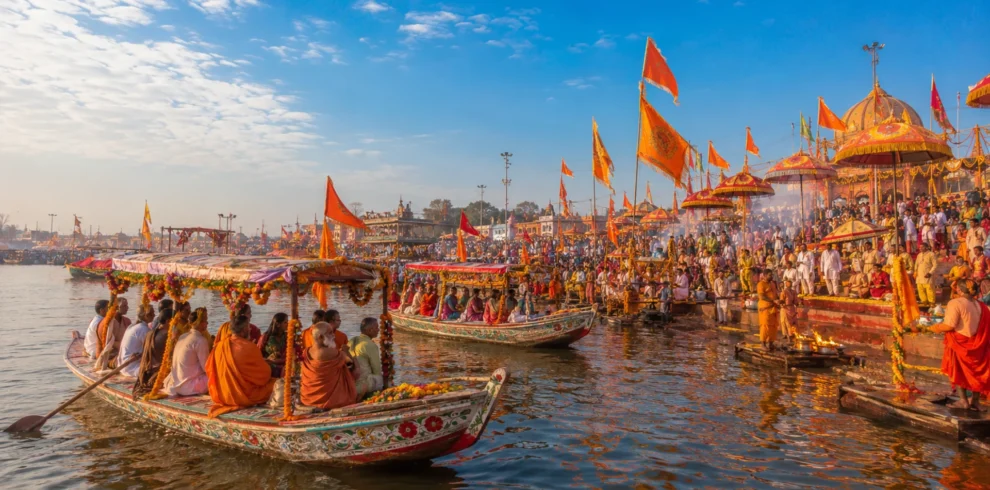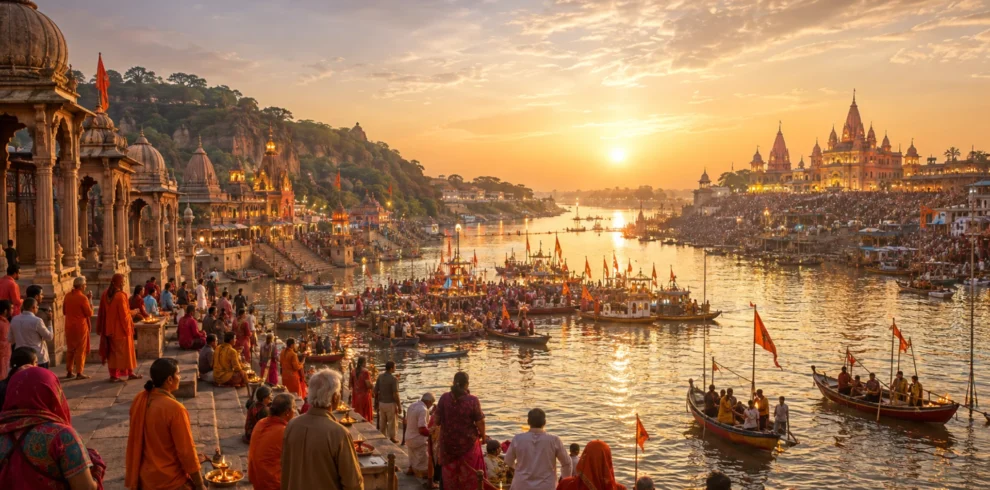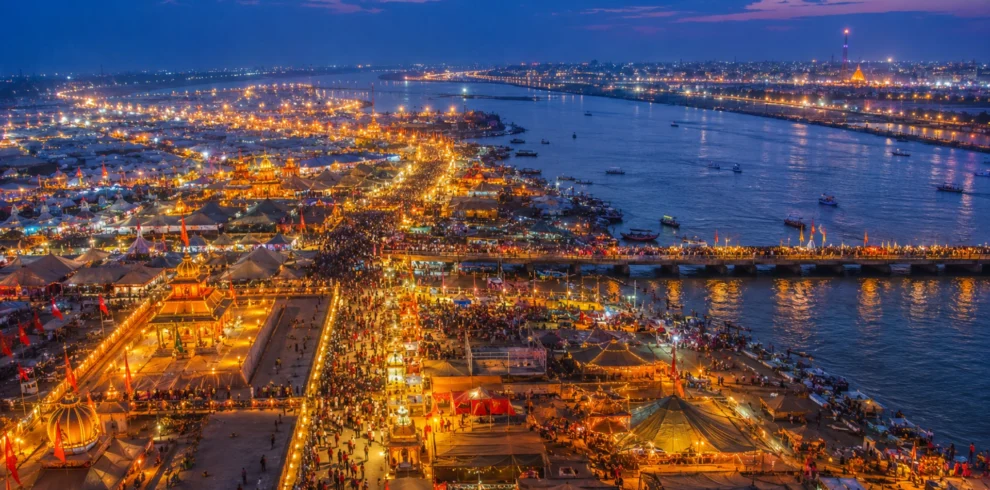
Prayagraj Kumbh Mela is one of the world’s most significant religious and spiritual gatherings. Held at the sacred Triveni Sangam, where the Ganga, Yamuna, and traditionally believed invisible Saraswati meet, the festival attracts millions of pilgrims, saints, sadhus, Naga Sadhus, Kalpvasis, spiritual seekers, and visitors.
Prayagraj is said to be Tirthraj which means “King of Pilgrimage“. Owing to its holy geography, antiquity, temples and connection with Kumbh tradition, Prayagraj is considered one of the holiest pilgrimage sites in India.
The Kumbh experience is centered around sacred bathing, spiritual practices, religious processions, Akharas, satsangs, and visits to important temples and pilgrimage sites. For travelers, it is also an opportunity to experience India’s living spiritual and cultural traditions on an extraordinary scale.
Whether you’re planning your pilgrimage or seeking knowledge about this magnificent event from afar, join us as we delve deep into everything you need to know about Prayagraj Kumbh Mela a journey that promises enlightenment at every turn!
Introduction to the Prayagraj Kumbh Mela
Prayagraj Kumbh Mela is regarded as one of the biggest events celebrated across the globe every 12 years when pilgrims take holy dip on holy trinity convergence point. Think about hordes of people gathered at one place celebrating their religion with full zeal.
Kumbh Mela is a major Hindu pilgrimage festival traditionally associated with four sacred locations in India:
- Prayagraj
- Haridwar
- Nashik-Trimbakeshwar
- Ujjain
Each location has its own religious and astrological significance.
Prayagraj holds a particularly important place in the Kumbh tradition because of the Triveni Sangam, the sacred confluence of the Ganga, Yamuna, and the invisible Saraswati.
According to Hindu tradition, the Kumbh is connected with the story of the Samudra Manthan, or the churning of the cosmic ocean, during which the divine nectar of immortality, Amrit, emerged.
The four locations associated with the Kumbh tradition are believed to be connected with the legend of drops of this divine nectar falling on Earth. The Prayagraj Mela Authority is the government-established body responsible for organizing and administering major mela events in Prayagraj, including Kumbh and Maha Kumbh gatherings.
History of the Kumbh Mela: Origins and Evolution
The Kumbh Mela has a rich tapestry of history that dates back thousands of years. It is believed to have originated during the ancient Vedic period, rooted in Hindu mythology and tradition.
Legend has it, Gods & demons churned the ocean to gain “amrit” or ambrosia. Whoever drank this immortal fluid fought long battles over it. Kumbh stands for the pot which contained this heavenly potion or enlightenment.
Over centuries, this grand gathering evolved from small regional events into a colossal festival attracting millions. Historical texts mention its first significant occurrence in 1900 AD at Prayagraj, where devotees flocked to seek blessings. With each cycle occurring every twelve years the event adapts while preserving its sacred essence. Today’s Kumbh Mela is not merely a religious ritual; it reflects India’s diverse culture and spirituality on an unparalleled scale.
Why Is Prayagraj So Important for Kumbh Mela?
The spiritual importance of Prayagraj is closely connected with the Triveni Sangam. The three rivers traditionally associated with the Sangam are:
- Ganga – The Ganga is one of the most sacred rivers in Hinduism and is revered as a divine mother.
- Yamuna – The Yamuna is another major sacred river with deep connections to Hindu mythology and traditions.
- Saraswati – The Saraswati is traditionally believed to flow invisibly beneath the earth and meet the Ganga and Yamuna at the Sangam.
The confluence of these three rivers is known as the Triveni Sangam. Prayagraj tourism official site states Sangam as “place where Ganga, Yamuna & mythological Saraswati meet” and lists it among one of the holiest pilgrimage centres in Prayagraj.
Spiritual Significance of the Kumbh Mela
Kumbh Mela is very important festival for crores of people. Millions of people attend the Kumbh Mela every few years as it is believed to help wash away their sins and free them from repeated reincarnation. Bathing in the Holy Kumbh is supposed to purify you of your sins.
For millions of devotees, the Kumbh Mela is a journey of faith and spiritual renewal.
The festival is associated with:
- Sacred bathing
- Spiritual purification
- Prayer and meditation
- Religious discourses
- Satsang
- Charity and service
- Meeting saints and spiritual teachers
- Visiting temples
- Performing rituals at the Sangam
Popular belief holds that dipping oneself into holy waters at a good Kumbh period will purge spiritual sin and accrue merit. Some visitors come to truly experience this for themselves, not just bathe in the river. They seek deeper fulfilment in devotion, self-reflection and experience with India’s past spiritual culture.
What Is Triveni Sangam?
The Triveni Sangam is the most important pilgrimage attraction in Prayagraj.
It is traditionally believed to be the point where:
Ganga + Yamuna + Saraswati = Triveni Sangam
The Ganga and Yamuna can be seen meeting at the confluence, while the Saraswati is traditionally believed to be invisible. The Sangam is the spiritual heart of Prayagraj Kumbh Mela. During the Kumbh, millions of pilgrims gather in the wider Sangam area for sacred bathing and religious activities.
Visitors can also experience the Sangam by boat, subject to local operating arrangements and safety regulations.
Holy Bath at Triveni Sangam
Taking a holy bath, or Snan, is one of the central traditions of the Kumbh Mela. Devotees traditionally believe that bathing in the sacred waters during auspicious periods can provide spiritual purification.
A typical pilgrimage experience may include:
- Reaching the designated bathing area.
- Offering prayers.
- Taking a sacred dip.
- Performing rituals according to personal traditions.
- Visiting nearby temples.
- Participating in spiritual activities.
During major bathing days, the number of pilgrims can increase dramatically. Visitors should follow all official instructions regarding bathing locations, access routes, crowd movement, and river safety.
What Is Amrit Snan or Shahi Snan?
Shahi Snan has been the term traditionally reserved for ritual bathing by Akharas and other groups of ascetics at Kumbh Melas. Usage of Amrit Snan is also gaining currency. These baths are among the largest and most elaborate spectacles of the Kumbh. Akharas and groups of ascetics lead large religious processions before bathing in the sacred water.
The processions may feature:
- Naga Sadhus
- Saints
- Mahants
- Religious flags
- Traditional music
- Devotional chants
- Ceremonial processions
For visitors, witnessing these traditions can be an unforgettable cultural and spiritual experience. However, it is important to maintain respectful behaviour and follow crowd-control instructions.
Naga Sadhus at Prayagraj Kumbh
Naga Sadhus are among the most recognizable ascetics associated with the Kumbh Mela. They belong to particular ascetic traditions and are known for their renunciation and spiritual discipline. Their presence at Kumbh gatherings is deeply connected with the history and traditions of Akharas.
Visitors may see Naga Sadhus participating in:
- Religious processions
- Amrit Snan
- Spiritual gatherings
- Religious discussions
- Akhara activities
Travelers should remember that Naga Sadhus are religious practitioners. Photography and interaction should always be approached respectfully, and visitors should follow any restrictions or requests made by individuals or Akhara authorities.
What Are Akharas?
Akharas are traditional Hindu monastic and ascetic organizations. They have played an important role in preserving religious teachings, spiritual practices, ascetic traditions, and the Guru-Shishya tradition.
During Kumbh Mela, Akharas have a prominent role in:
- Religious processions
- Ceremonial bathing
- Spiritual gatherings
- Religious discourses
- Traditional rituals
The Akharas are an essential part of the cultural and spiritual identity of the Kumbh Mela.
Kalpvas During Prayagraj Kumbh
Kalpvas is a traditional spiritual practice associated with the Magh period at Prayagraj. A Kalpvasi typically spends an extended period near the Sangam, following a disciplined lifestyle focused on:
- Sacred bathing
- Prayer
- Meditation
- Spiritual practices
- Simple living
- Religious discourses
The Kalpvas tradition demonstrates the deeper spiritual dimension of Prayagraj’s pilgrimage culture.
Important Places to Visit During Prayagraj Kumbh
A visit to Prayagraj can include many important temples, religious sites, historical monuments, and cultural attractions.
- Triveni Sangam – The most important pilgrimage site and the spiritual center of the Kumbh Mela.
- Ram Ghat and Sangam Ghats – Important areas for river rituals and pilgrimage activities.
- Bade Hanuman Ji Temple – A famous temple dedicated to Lord Hanuman, known for its unique reclining idol.
- Akshayavat – The sacred immortal banyan tree associated with ancient religious traditions.
- Patalpuri Temple – An ancient underground temple associated with the sacred area near the fort.
- Allahabad Fort – The historic fort built during the Mughal period stands near the Sangam and is an important landmark of Prayagraj. Access to some areas may be restricted, so visitors should check current entry arrangements.
- Mankameshwar Temple – A revered Shiva temple and an important religious site in Prayagraj.
- Alopi Shankari Temple – A significant Shakti pilgrimage site associated with Prayagraj’s religious heritage.
- Nagvasuki Temple – An ancient temple dedicated to Nag Vasuki on the banks of the Ganga.
- Anand Bhavan – The historic ancestral home associated with the Nehru family and India’s freedom movement.
- Chandra Shekhar Azad Park – A major historical and recreational landmark in the city.
- Allahabad Museum – A useful destination for visitors interested in art, archaeology, history, and culture. The official Prayagraj tourism portal highlights the city’s combination of religious, historical, architectural, and cultural attractions.
How to Reach Prayagraj
By Air – Prayagraj has its own airport, making air travel a convenient option for visitors. Travelers can also consider nearby airports such as Varanasi, Ayodhya or Lucknow, depending on flight availability and their itinerary.
By Train – Prayagraj is an important railway hub with connections to many major Indian cities. The city has several railway stations serving different routes. During major pilgrimage events, additional train services and special arrangements may be introduced.
By Road – Prayagraj is well connected by road with cities such as:
- Varanasi
- Lucknow
- Ayodhya
- Kanpur
- Delhi
- Agra
- Gorakhpur
Travelers should check event-specific traffic restrictions before travelling during major Kumbh periods.
Where to Stay During Prayagraj Kumbh Mela?
Accommodation options may include:
- Hotels – Suitable for families and travelers seeking comfortable facilities.
- Budget Hotels – A practical choice for pilgrims looking for economical accommodation.
- Dharamshalas – Popular among religious travelers.
- Guest Houses – Suitable for families and small groups.
- Tent Camps – Temporary tented accommodation may be arranged during major mela periods.
- Premium Tent Accommodation – Some organized camps may offer luxury facilities and enhanced comfort.
- Accommodation in Nearby Cities – Depending on availability, travellers may also consider staying outside the immediate mela area and arranging transportation.
During major Kumbh events, accommodation should be booked as early as possible.
Prayagraj Kumbh Mela Tour Packages
Travel companies can create different packages depending on the traveler’s needs.
- 2 Nights / 3 Days Prayagraj Kumbh Package – Ideal for a short pilgrimage.
Possible inclusions:
- Hotel or camp stay
- Sangam visit
- Holy bath
- Local sightseeing
- Transfers
- 3 Nights / 4 Days Kumbh Package – Suitable for pilgrims who want more time for temple visits and sightseeing.
- Prayagraj + Ayodhya Package – A popular combination for travellers interested in visiting two major religious destinations in Uttar Pradesh.
- Prayagraj + Varanasi Package – Ideal for travellers who want to combine the Sangam pilgrimage with the spiritual atmosphere of Kashi.
- Prayagraj + Ayodhya + Varanasi Package – A comprehensive Uttar Pradesh pilgrimage circuit.
- Senior Citizen Kumbh Package
Can include:
- Comfortable accommodation
- Private vehicle
- Flexible itinerary
- Reduced walking
- Assistance throughout the journey
- Group Kumbh Package
Suitable for:
- Religious groups
- Families
- Friends
- Community organizations
- Corporate spiritual retreats
Prayagraj Maha Kumbh Mela package cost
Prayagraj Maha Kumbh Mela package cost, the price varied significantly depending on number of days, accommodation, group size, and whether you travelled on a major bathing day.
Approximate package cost examples
| Package Type | Approx. Cost |
| 2 Nights / 3 Days basic group package | ₹19,000–₹25,500 per person |
| 2 Nights / 3 Days standard package | Around ₹31,000 per person |
| 2 Nights / 3 Days premium accommodation | ₹34,500–₹53,000 per person |
| 3 Nights Shahi Snan package | ₹55,000–₹75,000 per person |
| Luxury tent accommodation | Could be significantly higher, especially on peak dates |
For a Shahi Snan-focused 3-night package, one operator listed prices from ₹55,000 to ₹75,000 per person, depending on group size.
Important: Peak bathing dates were much more expensive. For example, Kumbh Village listed 3-night peak-period accommodation at ₹48,000–₹150,000 per unit, depending on accommodation category and meal plan, with GST extra.
If you are looking for a Prayagraj Mahakumbh package for your family, the cost would range from ₹19,999 to ₹29,999 for a budget package and from ₹30,000 to ₹55,000 for a premium package.
Services a Trayaksh Yatra Company Can Provide
A professional pilgrimage travel company can arrange:
- Hotel booking
- Tent accommodation
- Railway station transfers
- Airport transfers
- Private cars
- Tempo Travellers
- Group buses
- Sangam transfers
- Local sightseeing
- Temple visits
- Boat arrangements, subject to availability
- Tour guides
- Meal arrangements
- Customized itineraries
- Senior citizen assistance
- Group travel management
- 24×7 travel support
When booking, travellers should always check package inclusions, exclusions, cancellation rules, and transportation restrictions.
Best Time to Visit Prayagraj Kumbh Mela
The ideal time depends on the traveler’s purpose.
For Major Religious Events – Travelers who want to experience major bathing ceremonies should plan around officially announced important bathing dates.
For a More Peaceful Experience – Visitors who want to explore temples and the city with comparatively fewer crowds may prefer non-peak days.
For Spiritual Immersion – Travelers interested in Kalpvas, satsang, and Akhara activities may choose a longer stay.
Always verify official schedules before making final arrangements.
How Many Days Are Enough for Prayagraj?
- 1 Day – Suitable for a quick Sangam visit and selected temple darshan.
- 2–3 Days
Recommended for:
- Sangam
- Holy bath
- Mahakumbh experience
- Major temples
- Local sightseeing
- 4–5 Days – Ideal for a more relaxed pilgrimage covering Prayagraj and nearby destinations.
- 6–7 Days – Suitable for a broader spiritual circuit covering. (Prayagraj + Ayodhya + Varanasi)
Prayagraj Kumbh Mela for Senior Citizens/Families
Senior citizens/Families can enjoy a comfortable pilgrimage with proper planning.
Recommended arrangements include:
- Hotel close to accessible transport points
- Private vehicle
- Flexible sightseeing
- Regular rest breaks
- Medical support
- Avoiding peak crowd periods where possible
- Assistance with luggage
A customized pilgrimage package can make the experience more comfortable and manageable.
How to Respect Kumbh Mela Traditions
Kumbh Mela is a sacred religious gathering, so visitors should behave respectfully.
Visitors should:
- Dress appropriately.
- Respect religious ceremonies.
- Ask permission before photographing saints.
- Avoid disturbing Naga Sadhus.
- Follow Akhara rules.
- Keep the Sangam and ghats clean.
- Avoid littering.
- Follow queues.
- Respect local residents.
- Follow instructions from authorities.
- Avoid spreading unverified information.
The best way to experience Kumbh is with an attitude of humility, patience, and respect.
Why Should You Visit Prayagraj Kumbh Mela?
Prayagraj Kumbh is much more than a religious festival.
It offers an opportunity to experience:
- The sacred Triveni Sangam
- Holy bathing traditions
- Naga Sadhus
- Akharas
- Spiritual discourses
- Religious processions
- Temple traditions
- Indian culture
- Ancient pilgrimage practices
It is a unique experience where spirituality, faith, culture, history, and community come together on an extraordinary scale.
Cultural Events and Activities at the Kumbh Mela
Cultural programs organized in Prayagraj Kumbh provide a colourful milieu to the festivity. Attendees indulge themselves in witnessing classical music performances. Indian Folk dances and Bhajans are held at various platforms. Talented artists from across India present these programs.
The event is also a platform for spiritual discourses led by revered saints and gurus. These enlightening talks captivate audiences seeking wisdom about life and spirituality.
Workshops on yoga and meditation promote mental well-being amidst the hustle, making it a holistic experience for all who attend.
Conclusion: Why You Should Experience the Prayagraj
Prayagraj Kumbh Mela is one of India’s most extraordinary pilgrimage experiences. At the sacred Triveni Sangam, millions of devotees come together to participate in holy bathing, prayer, religious ceremonies, spiritual gatherings, and ancient traditions.
From the sacred waters of the Ganga and Yamuna to the presence of Akharas and Naga Sadhus, every part of the Kumbh reflects India’s rich spiritual heritage.
Whether you are planning a short pilgrimage, a family journey, a senior citizen tour, or a complete spiritual circuit covering Prayagraj, Ayodhya, and Varanasi, advance planning can make your experience smoother and more comfortable.
Before travelling for any future Kumbh or major mela event, always check the latest official announcements regarding dates, bathing schedules, registration, transportation, accommodation, traffic restrictions, and safety guidelines.
Plan a pilgrimage to Prayagraj and experience the sacred energy of the Triveni Sangam, one of India’s holiest spiritual sites, with our company, which will take care of every convenience for you.
Frequently Asked Questions About Prayagraj Kumbh Mela
1. Where is Prayagraj Kumbh Mela held?
2. What is Triveni Sangam?
3. Why is Prayagraj important for Kumbh Mela?
4. How can I reach Prayagraj?
5. How many days are enough for Prayagraj?
6. Can I combine Prayagraj with Ayodhya and Varanasi?
7. Where should I stay during Kumbh Mela?
8. Can senior citizens visit Kumbh Mela?
9. What should I carry?
10. How can I book a Prayagraj Kumbh tour package?
Take a look below at our most popular itineraries for a memorable trip to Prayagraj.