
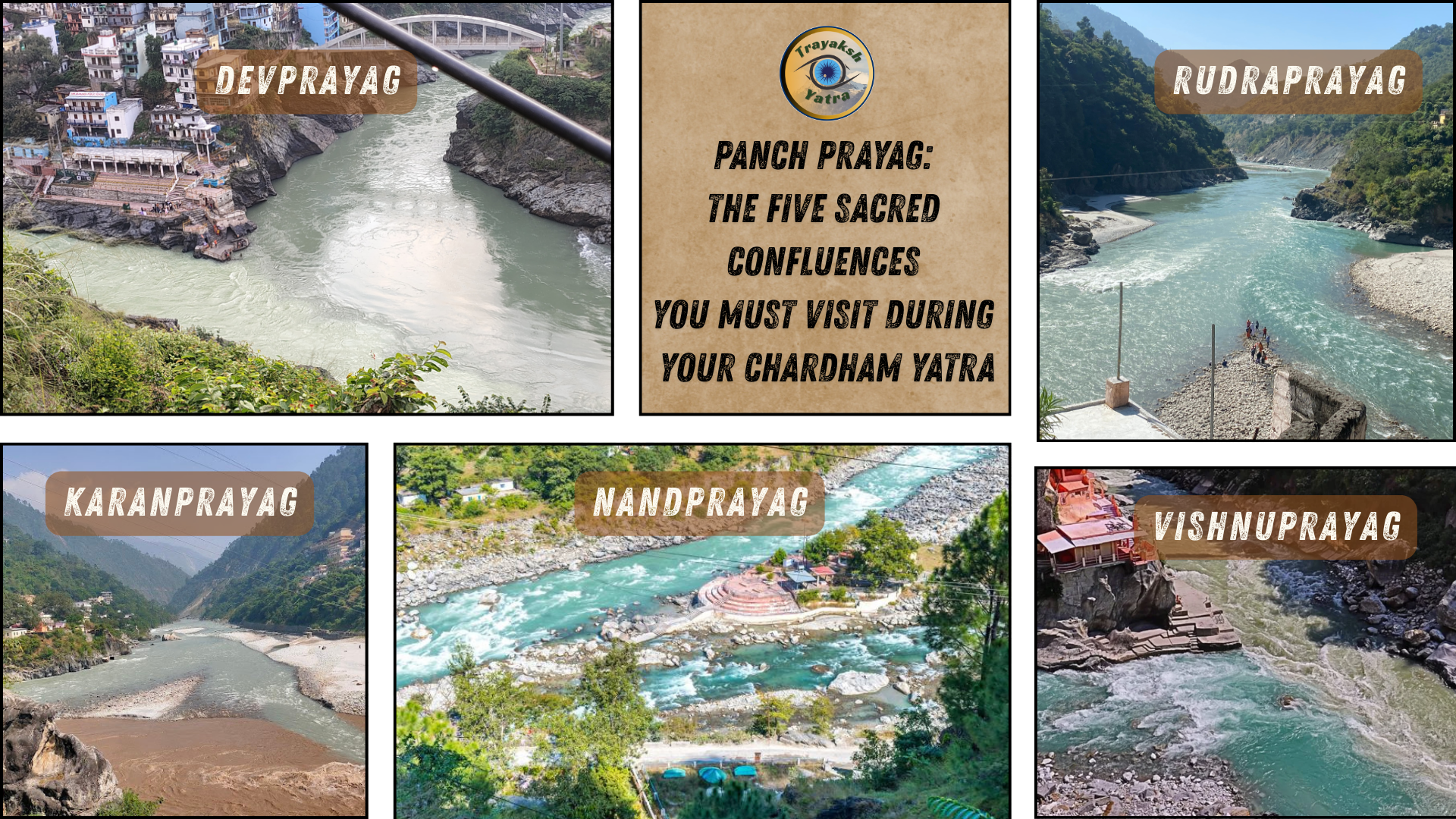
In the sacred tapestry of Uttarakhand’s spiritual landscape, the Panch Prayag stands as a divine constellation of five holy confluences, each marking the meeting points of revered rivers. These confluences Devprayag, Rudraprayag, Karnaprayag, Nandprayag, and Vishnuprayag hold immense religious significance and are intimately connected to the famed Char Dham Yatra, a pilgrimage that attracts millions of devotees annually. Char Dham Yatra 2026 can include a visit to these 5 confluences of Panch Prayag for added spiritual significance. The term Panch Prayag is a reference to 5 confluences present on the rivers in the Himalayan ranges. The confluences in India, especially the Prayags of Uttarakhand, are not just geographical features where two rivers meet but also have a sacred significance that often brings together mythology, devotion and the spiritual journey to connect with the divine. A visit to the Prayags often finds a special place in the hearts of many pilgrims going on a spiritual journey. In this article, we will explore the spiritual significance of each of these Prayags, their significance in mythology and their connection to the Char Dhams so that you can consider how a visit to these confluences can become a part of your Char Dham Yatra in 2026.
Brief overview of the five sacred confluences and their locations
Prayag literally means a confluence, more specifically of two or more rivers. In Hinduism, river confluences are traditionally regarded as holy because they are said to confer various spiritual merits and purifications. The Panch Prayag of Uttarakhand refer to five confluences of the Alaknanda River before it eventually transforms into the Ganges.
Every Prayag is different with its own significance, mythology and energy. All together they create a spiritual circuit that is a wonderful complement to the Char Dham Yatra. Many people combine a visit to one or more of these confluences with their journey to or from the four dhams – Yamunotri, Gangotri, Kedarnath and Badrinath.
Introduction of Panch Prayag
The five sacred confluences
- Devprayag: The Divine Confluence
Situated at an elevation of 830 m, Devprayag is the most important of the five Prayags. Alaknanda and Bhagirathi join at Devprayag to form the Ganges. As per Hindu mythology, it is at this confluence that the Ganges descended from the locks of Lord Shiva on to Earth, lending the place great religious significance.
If you are planning a Char Dham Yatra in 2026 then Devprayag is an ideal place to start your purification process. It is located at a distance of around 70 kilometers from Rishikesh on the way to Badrinath and it is very easily accessible at the beginning of your Yatra. The main attraction of the place is the ancient Raghunath Temple dedicated to Lord Rama. The temple provides a beautiful view of the rivers flowing beneath.
Yatri’s can expect to spend at least half a day at Devprayag and join the evening Ganga Aarti (ceremony of worship to the river) with its banks of flickering lamps at the confluence. The most ideal time to visit during the 2026 yatra season would be between May and June or September and October when the weather is most pleasant and the rivers run clear.
- Rudraprayag: Confluence of peace and power
The Lord’s name is marked by the name of the Lord Shiva Rudra and the Mandakini river of Alaknanda. This confluence of 895 meters upstream exudes the blessing where Lord Shiva in his Rudra form blessed the river to the sage who was performing penance here.
In 2026, the Chardham pilgrimage serves as the route decision for the Kedarnath branch, but the route to Badrinath continues to Alaknanda, the natural suspension point of the pilgrimage circuit.
The Rudranath temple of Lord Shiva is located near the confluence from where you can enjoy magnificent views of the converging rivers. Visit the confluence and take out some time to do the regular shloka at the confluence that involves a holy dip or sprinkling some water from the confluence and offering prayers to the Gods.
Another famous feature of Rudraprayag is the Jim Corbett’s man-eating leopard, so one can also spend some time and visit the museum.
- karanprayag: The Confluence of Charity
Karanprayag at an altitude of 788 m, is the confluence of the Alaknanda and Pindar rivers. As per the legend, the place is named after Karna of Mahabharata as it is believed that Karna did penance and charity at this site and hence was blessed by the gods.
Karanprayag is a place to ponder the glory of selfless donation for the 2026 Char Dham pilgrims. Uma Devi Temple in karanprayag is ancient, which worships Goddess Parvati. Karna Temple in karanprayag is dedicated to the namesake of the place. These temples depict the ancient architecture of the state and have ancient idols.
Karna Prayag’s position on the way to Badrinath makes it an ideal halting place for pilgrims on their way. Furthermore, since it serves as an approach to the more remote Nanda Devi Sanctuary, more adventurous pilgrims are able to extend their pilgrimage into the Nanda Devi sanctuary.
Pilgrims are encouraged to make ‘pind daan’ (offerings to the ancestors) at this confluence, which is believed to bring peace to the souls of the departed. The 2026 yatra will be more meaningful if it is timed with the local festivals such as Uttarayani which celebrates the sun moving to its northern hemisphere.
- Nandprayag: The Blissful Confluence
Nandprayag is formed by the confluence of the Alaknanda and the Nandakini at an altitude of 914 meters. It is named after king Nanda who did penance at this place, also it is called so because it is dedicated to the Goddess Parvati (who is also known as Nanda) and this confluence symbolises her happiness.
For Char Dham Yatris in 2026, Nandprayag is a quiet, meditative site by comparison with some of the other confluences. The Gopal Temple (Lord Krishna) and Nand Temple are major spiritual landmarks at Nandprayag. Steps down to the confluence on the stone steps have spots for meditation and contemplation.
Nandprayag is a cleaner and less crowded place. Pilgrims could very well spend some time here overnight and experience the spiritual side of Nandprayag during sunrise and the first rays of the sun after the confluence of both rivers. There is a local story that special rituals performed at this place give people the power to win over all hurdles they may face in their lives something visitors to the Nandprayag in 2026 can very well relate to after this pandemic.
- Vishnuprayag: The Preserver’s Confluence
The northernmost of the five confluences at a height of 1372 meters, Vishnuprayag, is where the Alaknanda joins the Dhauli ganga. The name means “the confluence of Vishnu”. It is the closest to Badrinath, the destination of pilgrims for which reason it is the first one of the five to be visited by pilgrims on their way to Badrinath dham. It is named so because Lord Vishnu is said to have performed tapasya (meditation) on this spot.
The mountainous terrain near Vishnuprayag is characterized by deep gorges and swift currents, embodying the concept of activity in spirituality. In the Char Dham season of 2026, visitors to Vishnuprayag can anticipate experiencing relatively lower temperatures at this higher elevation.
The Vishnu Kund is a natural pool near the confluence, considered to have medicinal properties. A symbolic touch of water ritual is performed here by pilgrims, before they set off for Badrinath. In the Vishnu Temple nearby, the deity is represented by an ancient black stone image, found in a meditative posture. For the 2026 yatra, the Vishnuprayag may have special arrangements to deal with increased number of pilgrims. Viewing platforms and ritual areas may be set up by the authorities to facilitate the yatra and safety.
In Conclusion: This completes our list of Panch Prayag of Uttarakhand. As you can see, the five confluences of Uttarakhand serve an important function during Chardham Yatra both from a spiritual and geographical point of view. The Panch Prayag is not only important for religious reasons, but also offers spectacular views of these important places of pilgrimage. There, one can really feel the breath-taking views and admire the beauty of the surrounding areas. One can also witness and experience the real essence of Hinduism during this spiritual experience. We hope that this article will give you at least some idea of the importance of this trip as well as the beauty of each of these holy places and encourage you to experience it yourself during your next Chardham Yatra.


